Endpoint Privilege Manager
Your first line of
defence, right at
the endpoint.
Iraje EPM extends privileged access governance to the endpoint removing standing local-admin rights, elevating only what's needed just-in-time, and recording, transcribing and analysing every privileged action.
- Removes permanent local admin rights

- Just-in-Time privilege elevation

- Records & transcribes every privileged session

- Application control & allowlisting

Endpoints are Ground Zero for Cyberattacks
Endpoints are the primary entry point for most cyberattacks and modern ransomware almost always begins there before spreading across the enterprise.
That's why endpoint security is now a central pillar of enterprise cybersecurity and why preventing privilege misuse at the endpoint matters more than ever.
Why endpoints are exposed ?
Users interact directly with emails and websites every day
Credentials are stored on the endpoint itself
Remote work has dramatically expanded the attack surface
Malware almost always starts at the endpoint layer
How One Click Becomes a Full Environment Takeover
EPM breaks the chain at privilege escalation, the step every attacker depends on.


A mature endpoint stack, with one critical gap
Most enterprise endpoints already run a deep security stack. But almost every layer is built to detect and respond. Very few are built to prevent.
LAPS
Local admin password rotation
DLP
Prevent data leakage
Encryption
Data Protection
Application Control
Application Control/Allowing
Iraje EPM
Prevent Privilege Misuse
NGAV
Signatureless threat detection
EDR
Detect malware, ransomware, lateral movement
UEBA
Detect abnormal user behaviour
Threat hunting
Identify Suspicious Activities
Vulnerability Assessment
Detect missing patches
XDR
Unified investigation and response
SOAR
Automated playbooks and incident response
Patch Management
Fix vulnerabilities
Endpoint Isolation
Quarantine compromised machines
Automated Remediation
Kill malicious processes
Why detection alone isn't enough?
Microsoft LAPS is the most common tool for local admin password rotation — but it only covers Windows endpoints, and only rotates passwords. EDR and XDR are powerful, but they are built to monitor, detect and respond after an attacker is already active.
EPM is the preventive control that precedes EDR/XDR — enforcing least privilege so the attack never escalates in the first place.
Firewall
LAPS
Iraje EPM
EDR XDR MDR
Antivirus
Device Management
Patch Management
Endpoint DLP
Encryption
BASIC → ADVANCED
EPM comes before detection — it prevents.
Prevention and detection solve different problems
EDR and XDR are built to detect and respond once an attacker is active. EPM is built to make sure the attack never escalates in the first place. The strongest endpoint security uses both.
Stops the attack from starting
Enforces least privilege so malware has no admin rights to execute, escalate or spread.
Detects the attack when it starts
Monitors endpoint processes, files and memory for suspicious activity, then reacts.
Connects & responds across systems
Correlates telemetry across endpoint, cloud, identity and email for coordinated response.
Detailed comparison
| Capability | Iraje EPM | EDR | XDR |
|---|---|---|---|
| Primary Objective | Enforce least privilege & control admin rights | Detect & respond to endpoint threats | Detect & correlate threats across ecosystem |
| Security Approach | Preventive (Zero Trust) | Detective + Reactive | Detective + Correlated Response |
| Core Function | Remove standing admin rights, enable JIT elevation | Monitor endpoints for suspicious activity | Aggregate telemetry across endpoint, cloud, identity |
| Attack Stage Covered | Before the attack executes | During / after attack execution | During & across the attack lifecycle |
| Admin Rights Control | Full control — remove, rotate, elevate | Limited / indirect | Not designed for this |
| Attack Surface Reduction | Very High — eliminates privilege misuse | Moderate | Moderate |
| Threat Detection | Focused on privilege behaviour | Strong endpoint detection | Strong cross-domain detection |
| Response Actions | Allow / deny elevation, session control, logging | Kill process, isolate device | Cross-domain automated response |
| Ransomware Protection | Removes rights & blocks elevation | Detects & stops encryption | Detects spread & correlates signals |
| Lateral Movement Control | Strong — no credentials to move with | Detects suspicious movement | Detects across identity + network |
| AI / Analytics | Focused on privilege behaviour | Behavioural analytics, threat intel | AI correlation across multiple signals |
| Coverage Scope | Endpoint privilege layer | Endpoint only | Endpoint + Cloud + Identity + Email |
| Compliance | Strong for least privilege & audit | Strong for incident detection logs | Strong for enterprise security posture |
| Dependency | Works standalone — the prevention layer | Needs preventive controls like EPM | Works best with identity + endpoint tools |
At a glance — across the attack lifecycle
| Stage | Iraje EPM | EDR / XDR |
|---|---|---|
| Threat Detection | Prevents misuse | No control |
| Visibility | Limited | Detects |
| Response Actions | Logs & audit | Focused on privilege behaviour |
| Ransomware Protection | Rotated hourly | Static |
| Lateral movement | JIT + recording | None |
| AI / Analytics | Recording + watermark | Partial |
“EDR / XDR tells you that you are under attack. Iraje EPM ensures the attack never succeeds.”
The core problem
"Too many users and applications running with local admin privileges."
The local administrator password is one of the most critical security elements in any enterprise it provides full control over the device. Yet endpoints are routinely left vulnerable.
Why endpoints get local admin rights
- Applications historically required admin access to run
- It was simply more convenient for IT support
- Legacy software carried hard dependencies on admin rights
…and the risk it creates
- Users install unauthorized and unmanaged software
- Malware instantly inherits admin privileges
- Security tools can be disabled; ransomware spreads rapidly
One compromised endpoint can quickly become an enterprise-wide incident.
Eight ways EPM secures every endpoint
By enforcing least privilege — giving users, applications and processes only the minimum access they need — EPM removes the conditions attackers depend on.
Removes standing admin rights
Strips permanent local admin privileges while users still complete authorized tasks.
Just-in-Time elevation
Monitors endpoint processes, files and memory for suspicious activity, then reacts.
Controls application elevation
Lets specific apps run elevated without ever making the user a local admin.
Stops malware escalation
Blocks the unauthorized privilege elevation malware needs to disable AV and encrypt files.
Application control & allowlisting
Trusted-application policies block unknown executables, scripts and shadow IT tools.
Reduces ransomware risk
Ransomware relies on privileged access — EPM removes rights and blocks elevation attempts.
Visibility & auditability
Records who requested elevation, which apps ran elevated, when, and what was done.
Improves compliance posture
Helps meet PCI-DSS, ISO 27001, NIST, CIS Benchmarks, RBI and CERT-In requirements.
Six pillars of next-gen endpoint privilege manager
Iraje EPM features are organised across six areas — Manage, Monitor, Control, Discover, Comply and Secure.

Manage
- Local admin password rotation for Windows endpoints every hour
- Just-in-Time (JIT) privilege elevation
- Secure privileged access to endpoints with workflow
- Manage remote accesses
- Multi-lingual support

Monitor
- Session recording of privileged activities on endpoints
- AI-assisted transcription of recorded sessions
- Live viewing of privileged sessions
- Seamless SIEM integration
- Forensic log analysis

Control
- Local admin governance
- Full audit trails for forensics
- Automated admin account lifecycle management
- Watermarking for all elevated accesses
- Reports & analytics for better decision making

Discover
- Discovery of endpoints across the enterprise
- Remote deployment and removal of agents
- Remotely enable / disable agents
- Manage remote accesses
- Shadow admin account detection

Comply
- Compliance with ISO, PCI-DSS, SOC 2, GDPR & NIST standards
- Mapping with RBI, SEBI, IRDAI, CERT-In, UIDAI & MeitY guidelines
- Pre-built reports for key regulatory compliances

Secure
- Tamper-proof agent for endpoints
- Zero Standing Privileges (ZSP)
- Secure access with workflow-based approvals
- Secure privilege escalation controls
- Prevents ransomware, phishing & lateral movement
Solution architecture
Simple to deploy. Redundant by design.
Iraje EPM has a deliberately simple architecture just one application server and one vault server. A redundant set of both can be deployed for seamless failover.
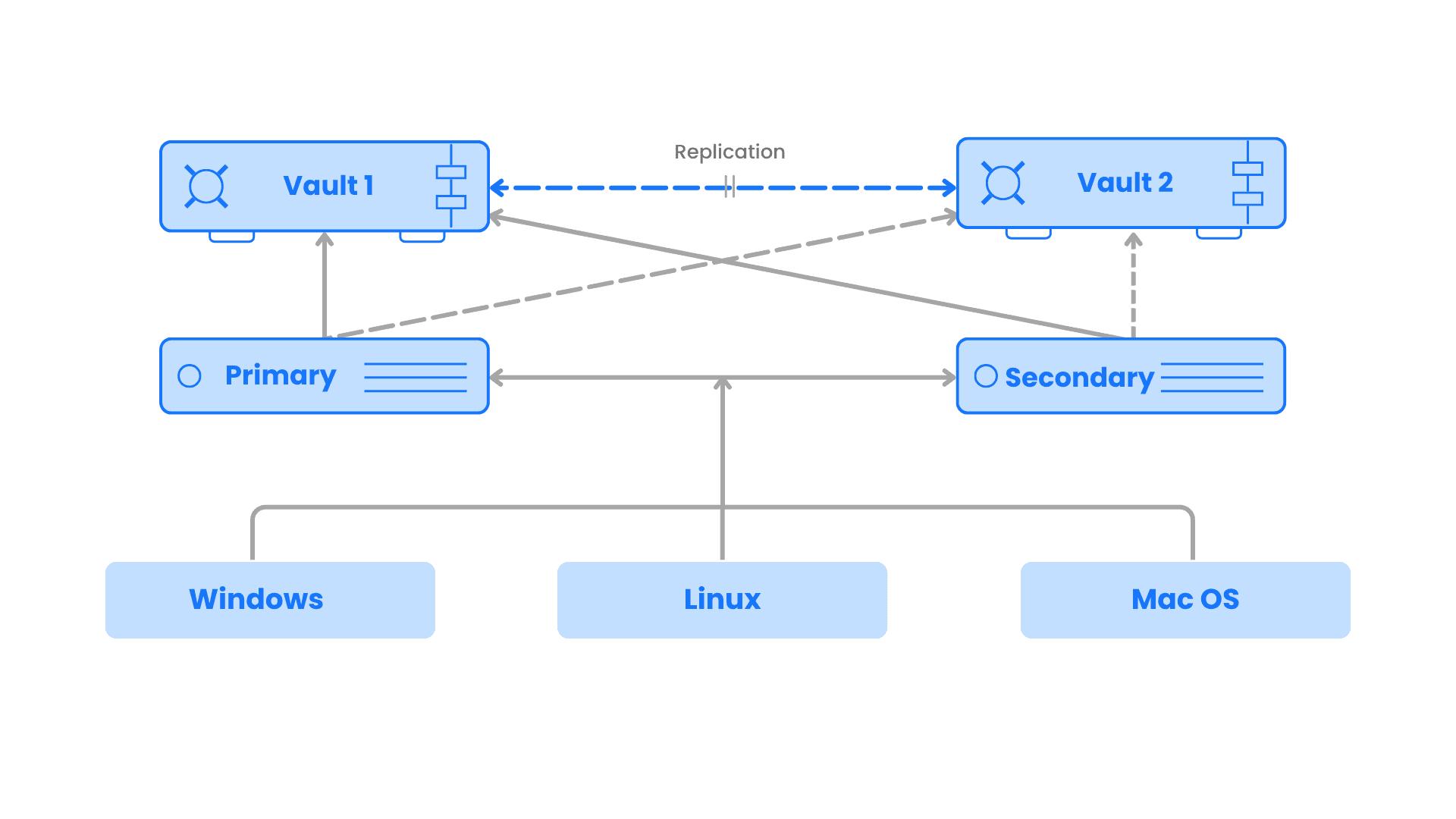
Application Server
Handles policy, workflow-based approvals and Just-in-Time privilege elevation across every endpoint.
Vault Server
Securely stores and rotates local admin credentials — no standing privileges, no exposed passwords.
Tamper-proof Agents
Lightweight agents on Windows, Linux and macOS endpoints remotely deployable and enforced.
Five reasons Iraje EPM stands apart
Capabilities engineered to prevent attacks — not just observe them.

Rotating local admin credentials every hour
Eliminates the risk of credential misuse by automatically rotating local admin passwords every single hour — no static passwords, no shared secrets.

JIT elevation of privileges with session recordings
Grant Just-in-Time access only when it's needed, and record every elevated session for complete accountability and audit readiness.

AI-enabled transcribed logs that integrate with SIEM
AI-enabled transcription of session activities creates intelligent, searchable logs that integrate seamlessly with your SIEM.

Watermarking of elevated sessions
Every elevated session is watermarked with user details, timestamp and device information — deterring misuse and ensuring full traceability.

Multilingual — available in 20+ global languages
A truly global solution supporting 20+ languages, empowering organizations to secure endpoints across diverse regions and workforces.
Mapped to endpoint-security regulation, worldwide
Iraje EPM maps directly to global standards and Indian regulatory requirements on endpoint security — with audit evidence built in.
Global standards
ISO 27001
Information security
SOC 2
Trust services
PCI-DSS
Payment card data
SOX
Financial controls
HIPAA
Healthcare data
EU GDPR
Data privacy
NIST
Cybersecurity
Compliance Mapping — Global
| Control Area | Compliance Requirement (Endpoint-Focused) | ISO 27001 | SOC 2 | PCI-DSS | SOX | HIPAA | GDPR | NIST | Audit Evidence | Iraje Compliance | |
|---|---|---|---|---|---|---|---|---|---|---|---|
| 1 | Least Privilege | Remove permanent local admin rights | A.5.15 | CC6.1 | Req 7.2 | ITGC | 164.308(a)(4) | Art.25 | AC-6 | Admin rights report | Yes |
| 2 | JIT Elevation | Temporary admin access with expiry | A.8.2 | Req 7.2.5 | Req 7.2 | ITGC | Addressable | Art.25 | AC-2 | Elevation logs | Yes |
| 3 | Privilege Escalation Control | Restrict unauthorized elevation | A.8.7 | Req 5.2 | Req 7.2 | ITGC | 164.308(a)(5) | Art.32 | SI-7 | Block logs | Yes |
| 4 | Privileged Activity Logging | Log admin actions | A.8.15 | Req 10 | Req 7.2 | ITGC | 164.312(b) | Art.30 | AU-2 | SIEM logs | Yes |
| 5 | Session Monitoring | Monitor admin sessions | A.8.15 | Req 10.2 | Req 7.2 | ITGC | 164.312(b) | Art.30 | AU-12 | Session logs | Yes |
| 6 | SIEM Integration | Centralized logging & alerting | A.8.16 | Req 10 | Req 7.2 | ITGC | 164.312(b) | Art.33 | SI-4 | SIEM dashboards | Yes |
| 7 | Access Reviews | Periodic admin access review | A.5.18 | Req 7.2.4 | Req 7.2 | ITGC | 164.308(a)(4) | Art.5 | AC-2 | Review reports | Yes |
| 8 | MFA for Privileged Access | MFA for admin login/elevation | A.5.17 | Req 8.4.2 | Req 7.2 | ITGC | 164.312(d) | Art.32 | IA-2 | MFA logs | Yes |
| 9 | Command & Script Control | Restrict PowerShell/CMD usage | A.8.7 | Req 5.2 | Req 7.2 | ITGC | 164.308(a)(5) | Art.32 | CM-7 | Execution logs | Yes |
Indian regulators
Iraje EPM controls — removing standing admin rights, escalation control, privileged activity logging and central SIEM monitoring — are mapped to the circulars and rules of India's regulators.
Get in touch
Make the endpoint your strongest line of defence.
See how Iraje EPM removes standing admin rights, rotates credentials hourly and stops ransomware before it starts.